ExpiredDomains.net is the free volume list. DomCop is the paid metrics grid. SpamZilla is spam-first triage. UpSnatch is for SEO, Local SEO, and workflow. CatchDoms and Karma.Domains add auction search with API or MCP. Domain Hunter Gatherer is a Windows desktop crawler. You still validate in Ahrefs, Majestic, and Wayback, and you buy at the registrar or auction.
For years, ExpiredDomains.net, DomCop, and SpamZilla were the main incumbents in expired-domain research. Now newer tools are entering the market and evolving quickly, adding new search, workflow, and automation features. For SEO experts, domainers, and agencies, that makes it harder to see which tool actually fits the job best.
Key takeaways
ExpiredDomains.net: 770M+ reported domains, 676 TLDs, fully free. Huge inventory, but fairly basic: mostly lists, filters, and metrics rather than deeper SEO discovery, spam analysis, or workflow tools.
DomCop: 29.5M+ domains, 90+ SEO metrics, from $816/year. Best for metric-heavy research, legacy Moz workflows, and bulk export.
SpamZilla: 26M+ domains, from $37/month. Best for PBN building, spam checking, backlink review, Wayback history, and private-list screening.
UpSnatch: 56.4M domains, 1,338 TLDs, free Classic Search on full db with 20+ filters (TLD, name, SEO metrics, quality), paid plans start at $10/month. Best for SEO, Local SEO, semantic search, and niche monitoring projects.
CatchDoms / Karma.Domains: interesting if you want to search auction inventory through API or MCP.
Domain Hunter Gatherer: Windows crawler from $27/month for keyword, niche, and competitor-site hunting.
There is no single winner; the best tool depends on whether you prioritize inventory, spam checks, SEO discovery, workflow, API access, or price.
Showing separate scoring dimensions, not one overall winner. Scoring details are at the end of this page.
What we compare
People use expired domain tools for different reasons. SEO agencies focus on strengthening and monitoring a niche, while PBN builders prioritize backlinks and spam quality over topical fit. Beginner domainers want a low-cost entry point while agencies need structured workflows for teams and clients. Users also look across different sources, from auctions and marketplaces to dropped domains.
We grouped these needs into six dimensions.
Dimension
What it covers
Inventory
How many domains are in the list, which TLDs it covers, and which listing types you can search (auctions, user auctions, dropped domains, marketplaces)
Spam
In-product due diligence: spam scores, Wayback checks, TF/CF, backlink profile, WHOIS history, historical titles, and similar risk signals
SEO
Finding names by meaning, niche, or place: semantic and neural search, backlink and Majestic signals, local SEO, projects, tags, and niche monitoring
Workflow
Day-to-day research after a name shows up: alerts, shortlists, favorites, comments, domain review, dashboards, and multi-client niche follow-up
API
Programmatic access: REST, MCP for Claude or Cursor, and search or domain-detail endpoints
Price
How easy it is to start: usable free search, a free preview, or a low paid floor; a strong Price score is cheap entry, not an overall value crown
ExpiredDomains.net is a free database of expired, deleted, pending-delete, and marketplace domains. It has by far the largest inventory in this comparison, driven mainly by deleted and dropped domains that are available to register again.
On September 1, 2026, it listed 770,072,691 domains: 584,501,477 deleted, 5,117,988 expired, and 60,969,489 marketplace names, across 29 lists and 676 TLDs. One caveat: ExpiredDomains.net works with separate lists, and the same domain can appear in more than one. It is unclear whether the reported total reflects unique domains or total list entries.
Users can browse lists such as Deleted Domains, TLD droplists, GoDaddy, Sedo, and Dynadot, then filter by keyword, regex, dictionary word, TLD, Majestic backlinks, Archive.org birth year, and more. Domain Name Search checks across lists for a known string. The service is fully free, registration and auction purchases happen at the registrars.
Dimension
Score
Why
Inventory
Best★★★
770M+ domains, huge deleted/dropped set free to register again
Spam
Limited★☆☆
Trust Flow and backlink count, no spam score, no Wayback abuse scan
SEO
Limited★☆☆
Keyword, regex, dictionary; no semantic search, Local Search, or Projects
Workflow
Limited★☆☆
Watchlist and saved searches; no bulk export for Ahrefs-style pipelines
API
No API-
No public API or MCP; bots and scrapers are banned
Price
Best★★★
The whole product is free
Domainers use it for high-volume browsing, ccTLD droplists, exact-string searches, regex, pattern filters, and wordlist hunting. Its biggest advantage for newcomers is simple: it is free.
If you need to process large batches of domains, ExpiredDomains.net starts to feel more limited. There is no public API, automated access is prohibited in the member area, and search results cannot be exported in bulk like they can with DomCop or UpSnatch. Most work stays list-by-list in the browser, which works well for manual scanning but less so for automated pipelines.
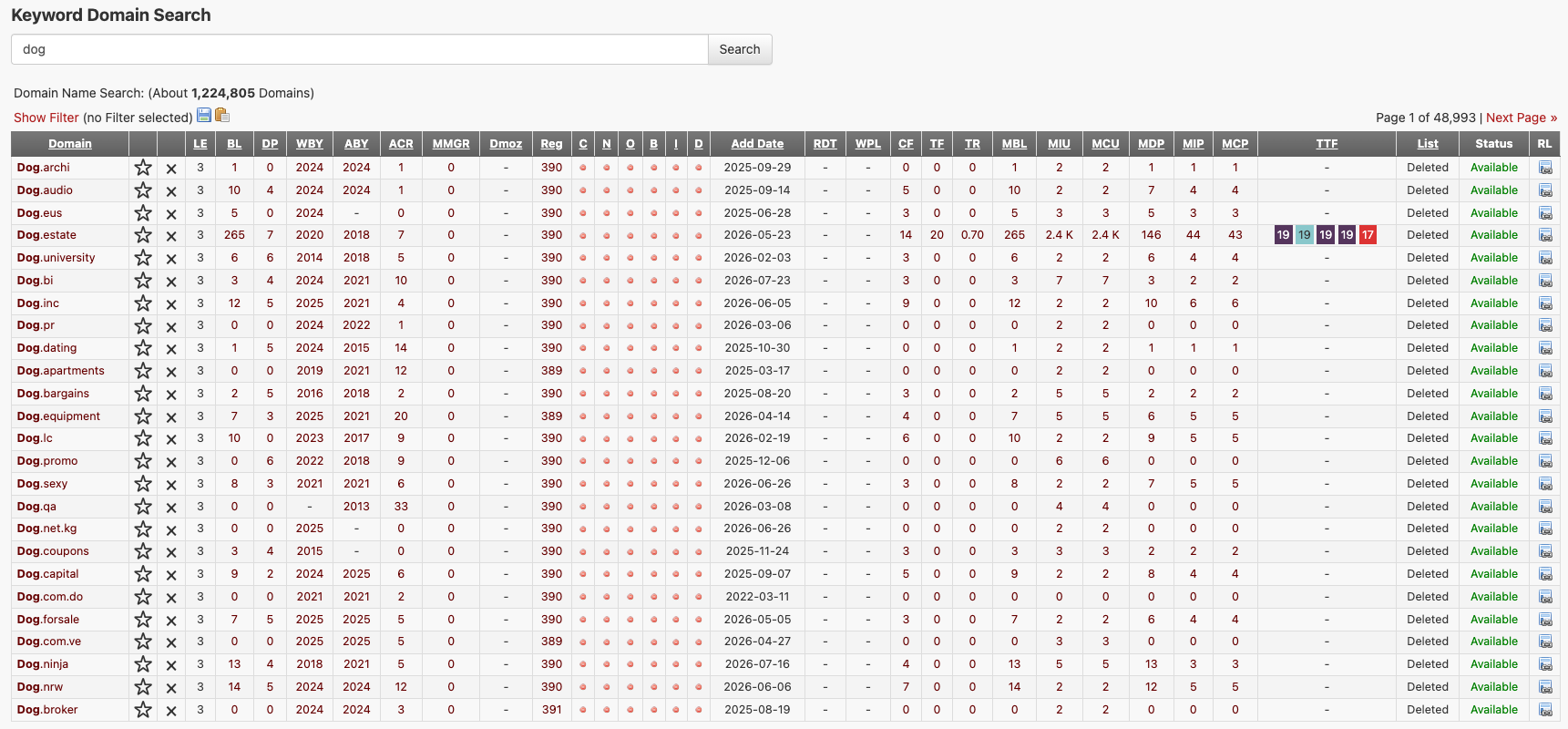
ExpiredDomains.net Keyword Domain Search results for dog
If you need deeper spam checks, SEO discovery, or team workflow features, ExpiredDomains.net is fairly basic. You can see Trust Flow and backlink counts, but there is no dedicated spam score or Wayback abuse scan. Search works well for keywords, regex, and dictionary terms, but not for semantic niche or local SEO discovery. You can save searches and watch domains, but there are no shared shortlists, comments, or workflow dashboards.
Best for: free volume lists, deleted/dropped domains, regex and wordlist hunting.
Skip when: you need Spam checks, SEO or Local SEO discovery, Niche monitoring, team Workflow, API access, or bulk export.
DomCop
DomCop is a paid expired-domain database for users who want a lot of SEO metrics in one place. You can search Expiring, Expired, and Archived domains and filter on Moz, Majestic, Ahrefs DR, SEMrush, Estibot, and more. Inventory includes expired, dropped, auction, marketplace, pending-delete, and closeout domains.
As of August 20, 2026, DomCop reported 29,546,993 domains. There is no free plan: Newbie costs $816/year and covers Expiring domains, while Power costs $1,152/year. Guru adds a personal crawler running on DomCop’s servers, with plans at $1,416, $2,832, or $4,272 per year depending on crawler count. DomCop helps you find and evaluate domains, but registration and auction purchases still happen elsewhere.
Moz Spam Score, spammy-name flag, TF/CF; no Wayback abuse scan
SEO
Good★★☆
90+ metric columns, keyword and pattern search; no semantic or Local Search
Workflow
Good★★☆
WatchList, saved searches, daily emails; no shortlists or comments
API
No API-
No public REST API or MCP
Price
Limited★☆☆
From $816/yr, no free plan
Ahrefs DR and Majestic's TF/CF are the gold standard in SEO these days. But if your company still uses Moz metrics in its domain criteria, DomCop is one of the few tools here that still supports that older workflow alongside DR and TF. That's also one of the reasons it's so expensive.
You can combine keyword and pattern filters with Majestic Topical Trust Flow, export domains in bulk, and use My Domains credits to score your own lists. Guru plans add a personal crawler that searches the live web for available domains beyond DomCop’s existing inventory. This used to be a big advantage, but nowadays crawling is just one prompt away with Claude or Cursor. And for most projects it's a one-off task (once you have the history you're good to go).
The biggest trade-off is price and discovery. There is no free search tier, and Newbie starts at $816/year. Search is still based on keywords and patterns, so broader niche research means trying synonyms manually. There is no semantic or Local SEO discovery, public API, or MCP.
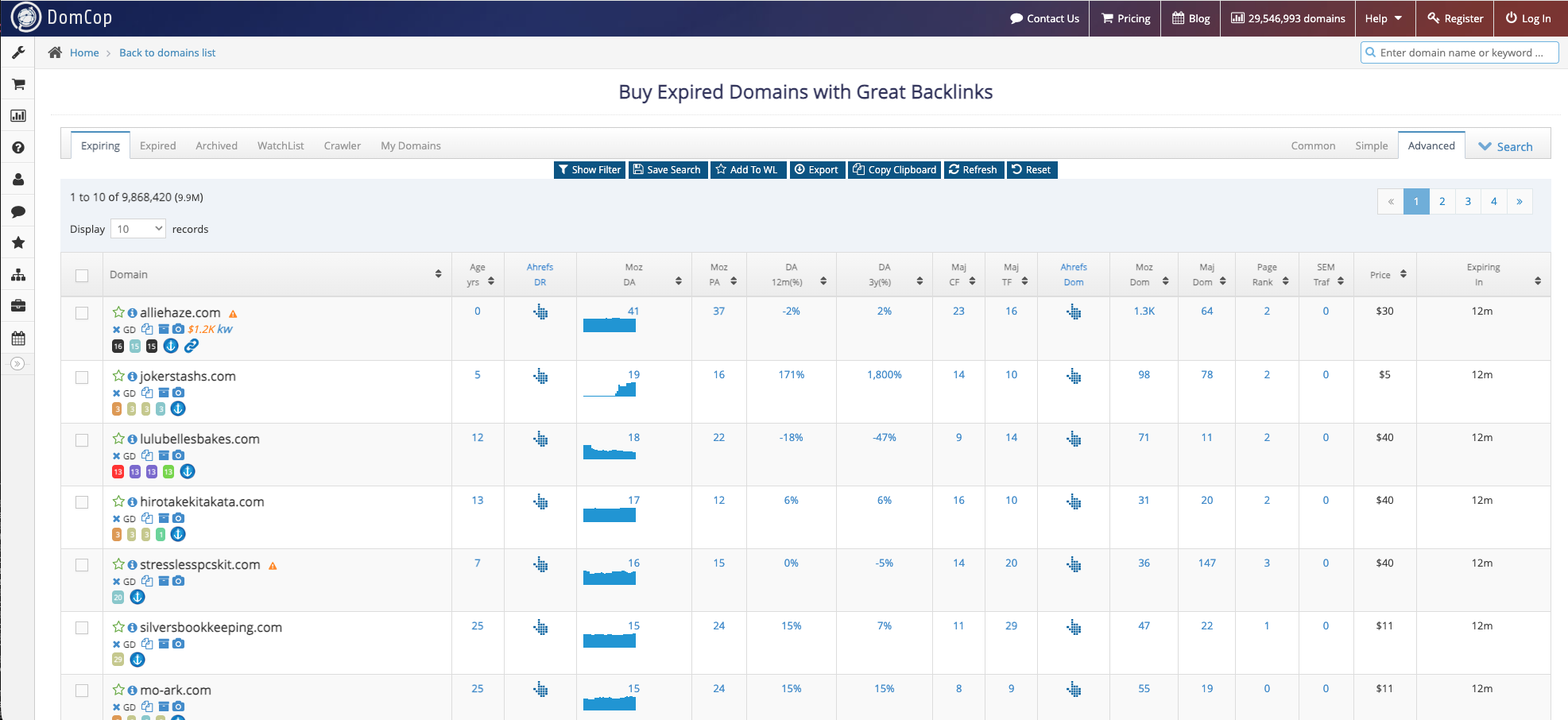
DomCop Expiring list in Advanced view, with Moz, Majestic, Ahrefs, and SEMrush columns
For spam checks, you get signals such as Moz Spam Score, TF/CF, and a spammy-name flag, but not a Wayback content abuse scan. Workflow features cover saved searches, daily Expiring emails, and a WatchList, without shared shortlists, comments, or a client operations dashboard.
Best for: metrics grid screening, bulk export, personal crawler on Guru plans.
Skip when: you need a free plan, SEO or Local SEO discovery by meaning or place, Niche monitoring, team Workflow with shortlists and comments, or API access.
SpamZilla
SpamZilla is a paid expired-domain database with a clear focus on PBN workflows. It calculates its own spam score (out of 100) and gives each domain dedicated tabs for backlink data, redirect history, WHOIS and drop history, WordCount, and archived Wayback content. The PBN focus is unusually explicit: the app even lets you connect accounts from PBN hosting services such as Easy Blog Networks, Bulk Buy Hosting, and LaunchCDN.
As of August 17, 2026, SpamZilla reported 26,013,957 domains across expired, dropped, auction, marketplace, pending-delete, and closeout inventory. Standard starts at $37/month, while the free tier is limited to 25 domain reviews. Paid plans also include credits to spam-check your own lists, ranging from 800 credits for $17 to 10,000 for $97, with the cost dropping from about $0.021 to $0.01 per domain at higher volumes. As with other tools, SpamZilla helps you find and vet domains, but registration and auction purchases still happen at registrars or dropcatchers.
70+ filters and native backlinks; no semantic or Local Search
Workflow
Good★★☆
Saved filters and daily emails; no shortlists, comments, or ops dashboard
API
No API-
No public REST API or MCP
Price
Good★★☆
From $37/mo, free: 25 reviews
If you don't care much about niches or topical authority and mainly look at backlinks and spam quality, SpamZilla is right up your alley. You can start from a keyword or your own list, then narrow domains using Majestic, Ahrefs, Moz, and SEMrush data before checking SpamZilla’s own spam score, backlink profile, redirect history, and archived content. You can also upload private lists and use credits to screen them in bulk, which is useful if you already source domains elsewhere.
Discovery is more limited. Search is still based on keywords and filters, so covering a broad niche means trying related terms yourself. There is no semantic or Local SEO discovery, no long-term niche monitoring, and no public API or MCP. The free tier is only useful for getting a feel for the product. With just 25 domain reviews, it is not practical for real research or screening.
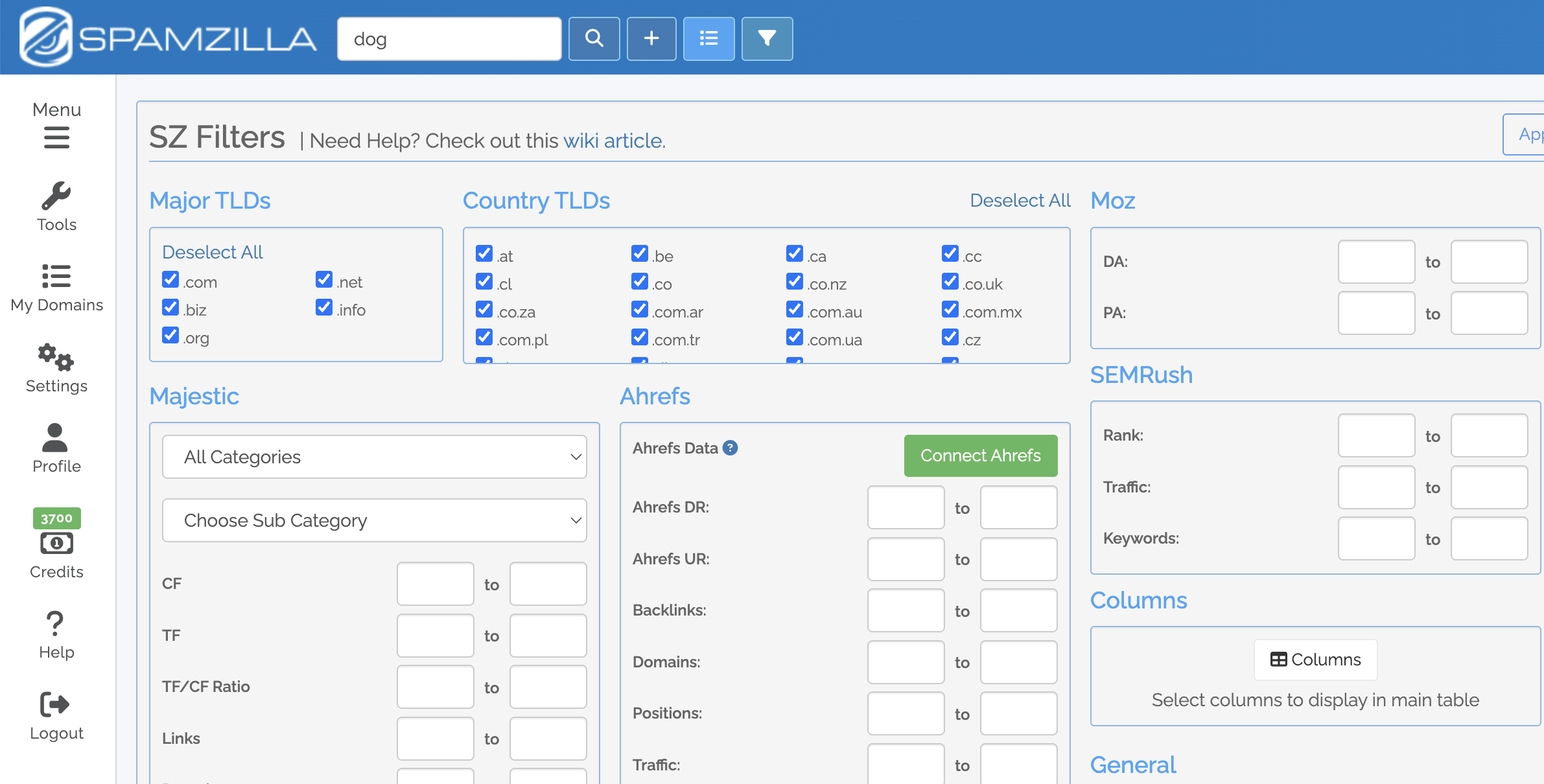
SpamZilla keyword search with SEO metric filters
The workflow support is fairly basic: you can save filters, use the tools and get daily emails when new matches appear, but there are no shared shortlists, comments, or client operations dashboard.
Best for: PBN building, spam-first screening, private-list spam credits.
Skip when: you need SEO or Local SEO discovery by meaning or place, Niche monitoring, team Workflow with shortlists and comments, full free inventory search, or API access.
UpSnatch
UpSnatch is a domain discovery tool for expired, dropped, auction, marketplace, pending-delete, and closeout domains, with a strong focus on SEO and discovery beyond exact keywords. It is one of the newer domain discovery tools in a market dominated by long-standing incumbents.
Magic Search, Local Search, Projects, Majestic and Ahrefs DR
Workflow
Best★★★
Projects, shortlist, comments, favorites, Radar
API
Good★★☆
REST + MCP on all paid plans (Explorer 1,000 rows/week, Pro 20,000 rows/day, OpenAPI, 2 tools): Classic Search and domain lookup
Price
Best★★★
Free Classic Search, paid from $10/mo
UpSnatch supports several smart search modes:
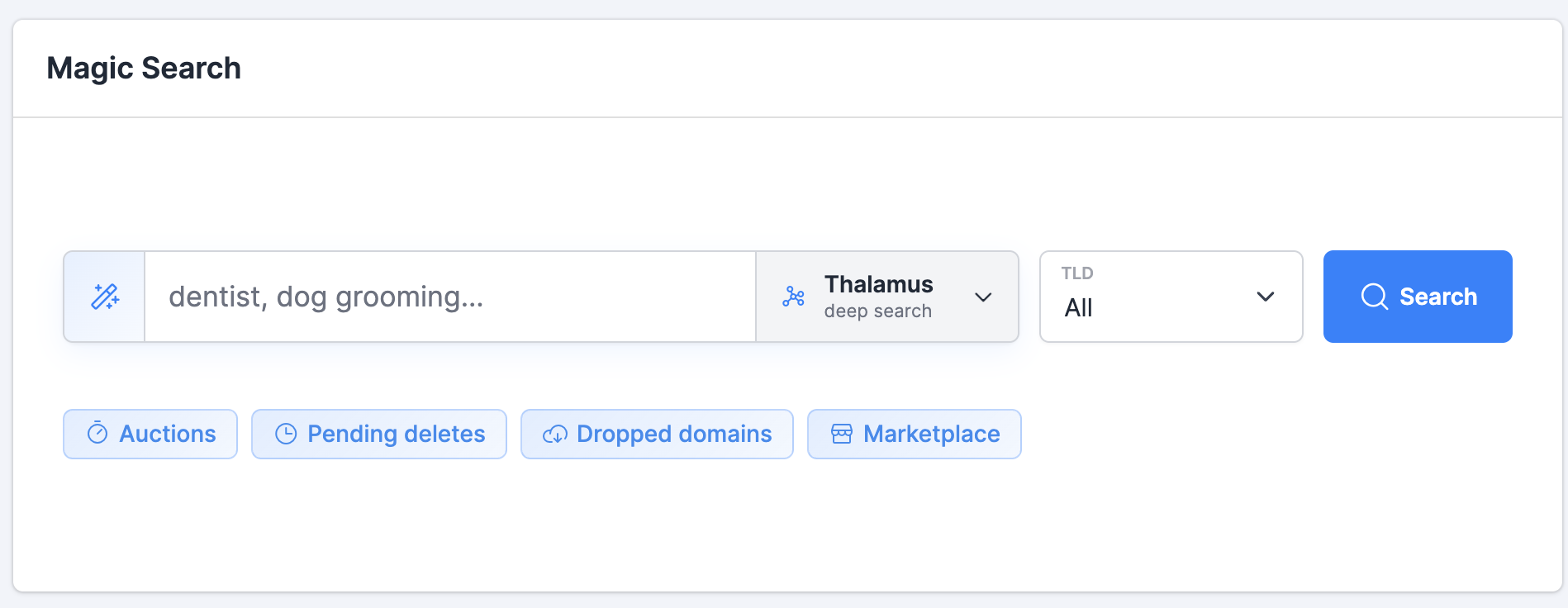
Magic Search uses multilingual semantic search to find names by meaning, so a search for dog can also surface related terms such as puppy, labrador, or chien.
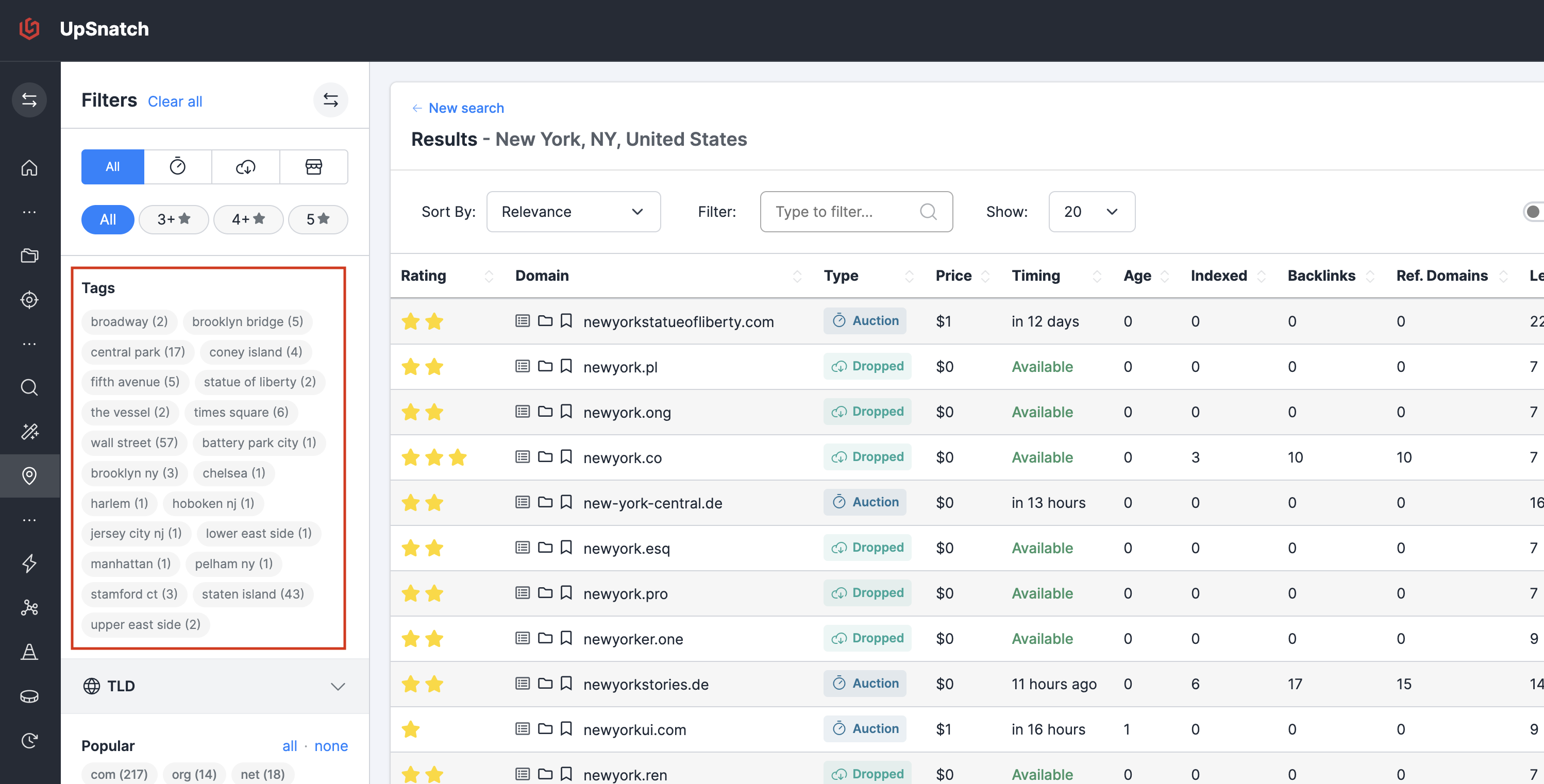
Local Search starts from a place you care about and shows expired, auction, and marketplace names that belong to that market: the city plus nearby neighborhoods and local context, not only domains that contain the city string.
Projects let you monitor a niche over time with shortlists, comments, and review workflows.
Classic Search provides keyword-based search and filters on the free plan, covering much of the same day-to-day search workflow as ExpiredDomains.net.
UpSnatch Magic Search
On September 1, 2026, UpSnatch indexed 56,420,717 domains across 1,338 TLDs (for reference, ExpiredDomains.net supported 676 TLDs on the same date). Availability detection for dropped domains is not yet equally reliable across every extension, but UpSnatch includes an in-app 'Check Availability' button to verify domains on demand.
Classic Search is free and lets you filter by keywords, name structure, SEO metrics, auction timing, and more. Paid plans start at $10/month for Explorer, $69 for Pro, and $149 for Agency. UpSnatch is not a registrar or drop-catching service, so registrations and auction purchases still happen elsewhere.
UpSnatch Local Search for New York with neighborhood tags
UpSnatch is built mainly for SEO and Local SEO workflows: semantic and location-based discovery, Projects, shortlists, comments, Domain Review, auction tracking, and alerts. Classic Search still covers the familiar database-and-filter workflow, but discovery and ongoing niche monitoring are the main differentiators.
Spam screening combines Spam Quality Labels, Majestic signals, TF/CF, backlink metrics, and a Wayback content abuse scan with summaries and recommendations, so you get more interpretation than SpamZilla’s more raw-data-heavy review. SpamZilla still goes deeper in areas like private-list checks, WHOIS history, and domain history.
UpSnatch is also one of the newer tools here and is evolving quickly, with frequent feature and integration releases. Since September 2026, all paid plans include a REST API and hosted MCP server for Classic Search and single-domain lookups, with an OpenAPI spec and setup for Cursor, Claude Code, and VS Code. Magic Search, Local Search, and Projects are not in the API yet, and the MCP has 2 tools where Karma.Domains offers 31.
Best for: SEO, Local SEO, Niche monitoring.
Skip when: you need the largest free volume list, a Moz-heavy metrics grid, a personal crawler, private-list spam credits, or API access to more than Classic Search.
CatchDoms
CatchDoms is a newer player that aggregates a small slice of live auction and marketplace inventory. The marketing page claims to ingest 21 platforms but the app itself only shows 20 sources, and only a small share of some marketplaces is actually indexed.
Selected listings include a quality score, Majestic TF/CF, Moz DA, backlinks, Wayback data, tech stack, and Google Business Profile flags. Bidding and registration still happen on the source platforms.
Dimension
Score
Why
Inventory
Limited★☆☆
Small curated auction slice; regfee and pending-delete only on higher plans; counts disagree on-site
Spam
Good★★☆
Score 0–100, is_spammy, TF/CF/Wayback on prioritized rows; no private-list credits
SEO
Good★★☆
Filters, GMB, NL assistant as filter helper; no Local Search, niche Projects, or other SEO support
Workflow
Good★★☆
Favorites, saved searches, notes
API
Best★★★
API on Pro+ (15 req/min Pro, 60 Authority)
Price
Good★★☆
Free Top 10 only; Pro €45/mo on EN card (Sep 2, 2026)
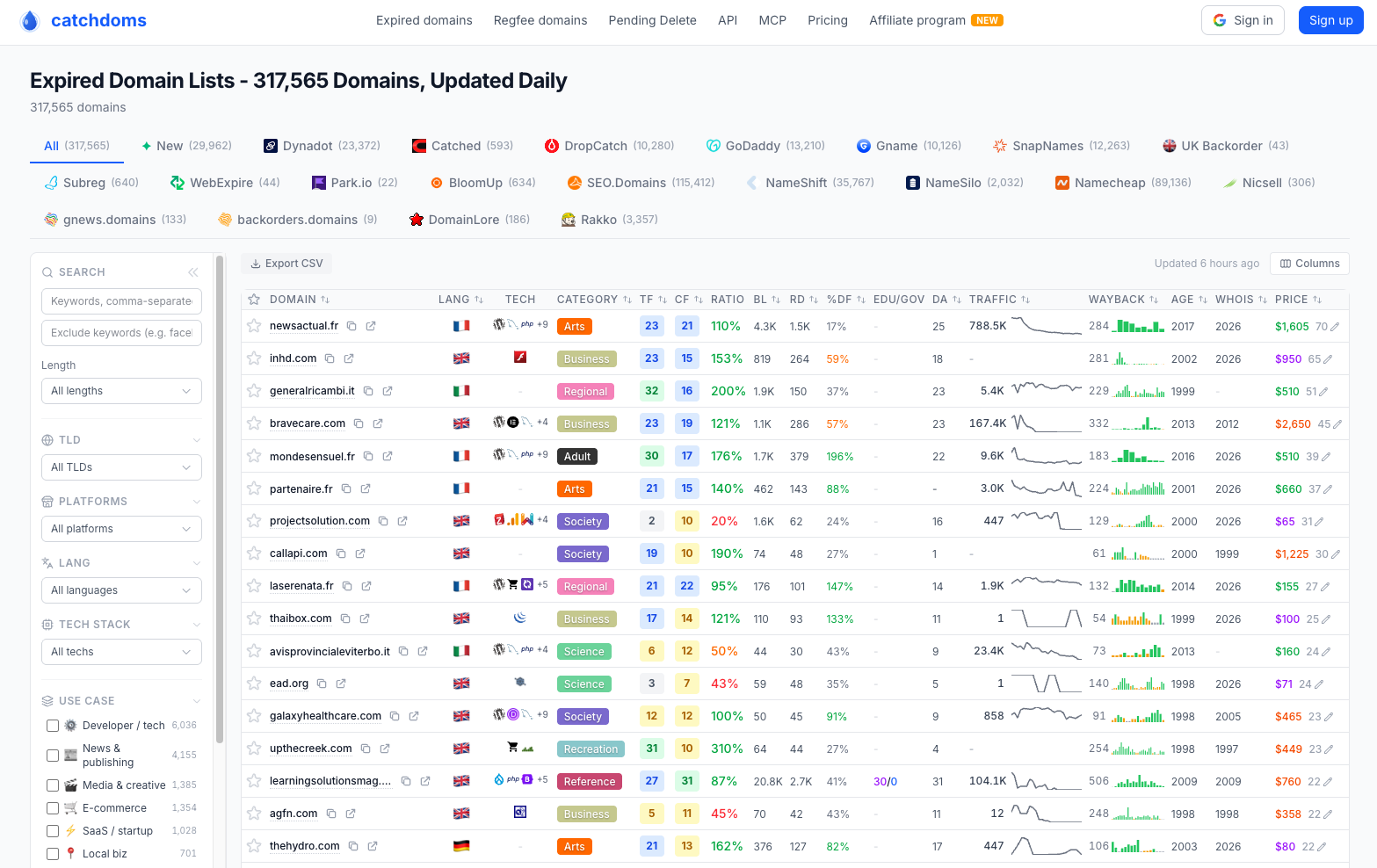
Inventory figures need context. On September 2, 2026, the homepage showed 317,565 live rows, while the pricing page advertised 469,942 auctions and marketplace listings, with no published reconciliation. Coverage per marketplace can be limited. On September 2, 2026, CatchDoms showed 35,767 NameShift listings, while NameShift itself had about 1.5 million. That means CatchDoms was showing only about 2.5% of NameShift’s inventory. In practice, CatchDoms seems to be a daily slice with enrichment rather than a full union of source inventories.
Free access is a mere preview to get a feeling of the tool. It exposes about 10 names, 5 favorites, and 3 saved searches. They have a 7-day Pro Lite trial where they cap pagination at 1,000 results. On September 2, 2026, Pro was €45/month, although older docs still showed €39/month or €468/year. Authority costs €89/month and adds about 164,067 “regfee” aged ccTLDs refreshed monthly. Authority+ costs €159/month and adds a weekly pending-delete feed of about 1.84 million rows, including large gTLD slices such as .com. Paid CSV exports are capped at 10,000 rows. Legal pages name SOFTLOGIC SASU in Marcq-en-Baroeul, France; other founder and brand names appear elsewhere, so ownership claims are best treated cautiously.
CatchDoms live auction and marketplace table with score and source chips (September 2, 2026)
CatchDoms might be useful if you want to scan for auctions using a REST API or MCP hook for Claude or Cursor, albeit a small subset of available domains. Although the sales pages claim so, the Authority / Authority+ are not unique inventory layers. They are paid views on deleted and pending-delete data that ExpiredDomains.net, DomCop, SpamZilla and UpSnatch already have. CatchDoms’ real pitch is packaging plus API, not exclusivity.
The weak points are trust in the headline numbers and research depth. Free is a teaser. Enrichment is prioritized, so not every row carries full TF/CF/Wayback even when marketing says “every domain.” During testing, the site was also unavailable several times, which made the overall experience feel less reliable. There is no semantic niche search, no Local SEO discovery, and no Projects-style shortlists, comments, or ops dashboard. Post-auction monitoring is still “coming soon.” Spam is a quality score plus an is_spammy flag and optional DMCA tool, not SpamZilla-style private-list credits. The in-product AI assistant translates natural language into filters; it is not Magic Search or a Karma-style Wayback report product.
Best for: auction-table aggregation with API/MCP
Skip when: you need verified full-marketplace coverage, SEO or Local SEO discovery by meaning or place, Niche monitoring, team Workflow with shortlists and comments, or a usable free inventory search.
Karma.Domains
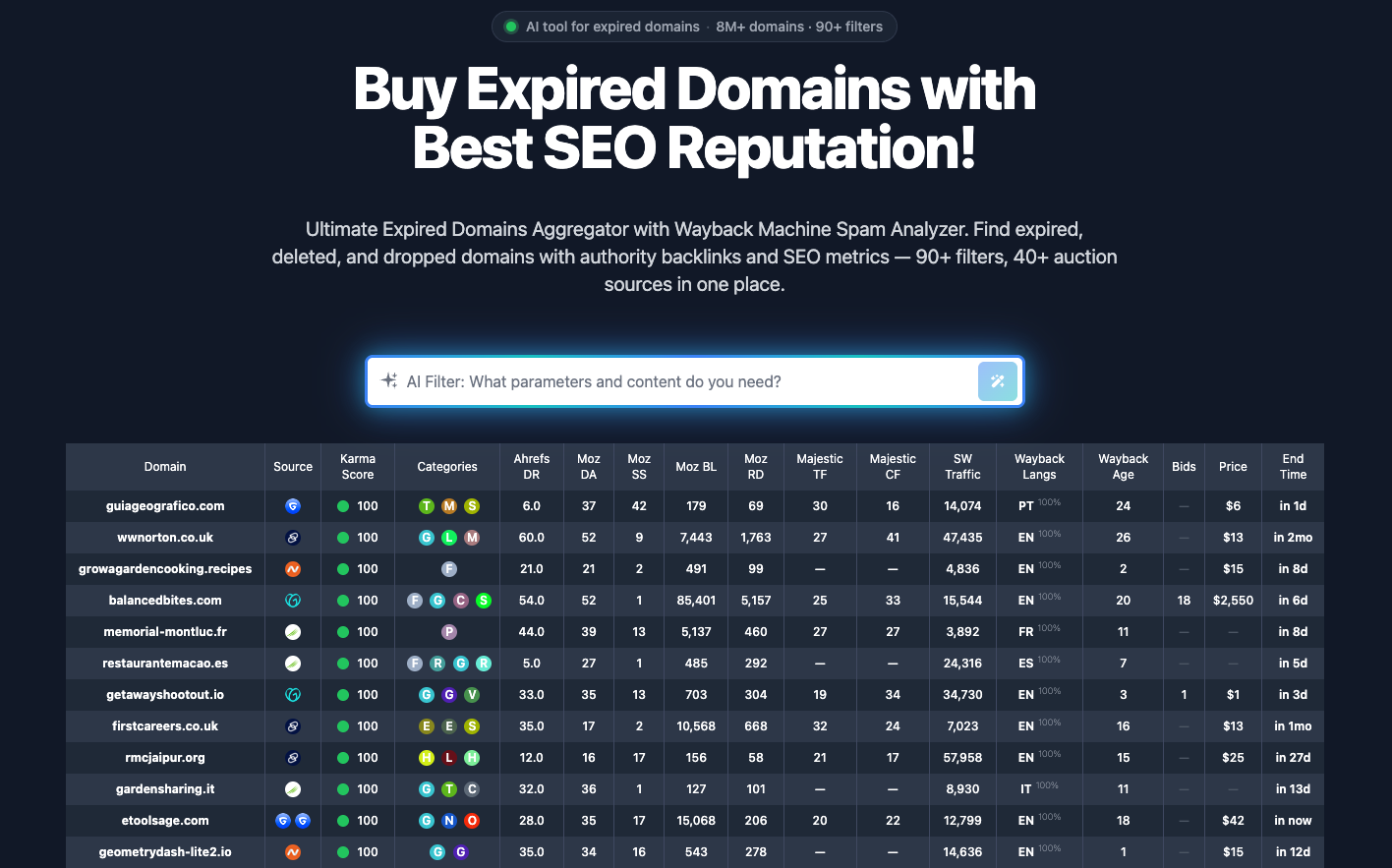
Karma.Domains is a paid expired-domain research tool with a strong focus on Wayback history and spam analysis. It covers auction, backorder, and register-now domains, with columns for Karma Score, Ahrefs DR, Moz DA and Spam Score, Majestic TF/CF, SimilarWeb traffic, and Wayback age. Bidding and registration still happen on the source platforms.
Karma.Domains advertises 8M+ domains, 90+ filters, and 40+ auction sources. Its help pages name roughly a dozen major sources, including GoDaddy, DropCatch, NameJet/SnapNames, Sedo, Dynadot, NameSilo, Namecheap, Sav.com, Park.io, and GNAME. The “40+ sources” figure is therefore best treated as a marketing claim rather than verified full-marketplace coverage.
Dimension
Score
Why
Inventory
Good★★☆
8.6M open list on Sep 2, 2026; auctions, expired, backorder; source count oversold
Spam
Good★★☆
Karma Score on Wayback content, Moz SS on-grid; no private-list credits
SEO
Good★★☆
DR + DA + TF/CF grid, NL filter fill; no Local Search or Projects
Workflow
Good★★☆
Saved filters, RSS, email digest, notes/tags; no ops dashboard
API
Best★★★
REST + MCP on Pro (60 req/min, OpenAPI, 31 tools)
Price
Good★★☆
Credits from $14.99; Unlimited $27.99/30d; Pro $57.99/mo
On September 2, 2026, Karma.Domains showed 8,627,464 rows: about 7.5 million auction domains and 1.12 million expired domains available to register. Karma’s FAQ claims 400,000+ new domains are added each day, while several landing pages say 400,000+ are processed. Those are not the same. We cannot audit the ingest, so likely we have to treat 400k as unaudited throughput on the public ~8.6M snapshot (auctions, closeouts, register-now), not a verified 400k net-new auction lots.
According to Karma.Domains, the Expired section is fed from multiple sources but consists mainly of domains that were not acquired at auction and later dropped back into open registration.
Free access is mainly a demo plus signup credits. Individual reports start at $14.99 in credits, Unlimited costs $27.99 per 30 days for full database access, and Pro costs $57.99/month with REST API and hosted MCP. Some rows still lack full enrichment, and live checks or missing metrics can consume additional credits.
Karma.Domains open domain list with Karma Score, Ahrefs DR, and Moz DA (September 2, 2026)
Karma.Domains is most useful if you want to inspect Wayback history or automate checks through its API. Its 'AI Filter assistant' expands a natural-language query into regular filters, but it is not a neural discovery engine like UpSnatch’s Magic Search. The catalog is expiry-cycle inventory (auctions, closeouts, drops, register-now), not a separate aftermarket marketplace.
The weak points are paid depth and discovery limits. Full reports sit behind credits or Unlimited/Pro. There is no Local Search, no Projects shortlists, and no SpamZilla-style private-list spam credits. About lists founders in Buenos Aires and Bali with no filed legal entity on the page.
Best for: Wayback spam reports, searching auctions via API/MCP
Skip when: you need a free mega-list, Local SEO or Niche monitoring, team Workflow with ops dashboards, or Spam private-list credits.
Domain Hunter Gatherer
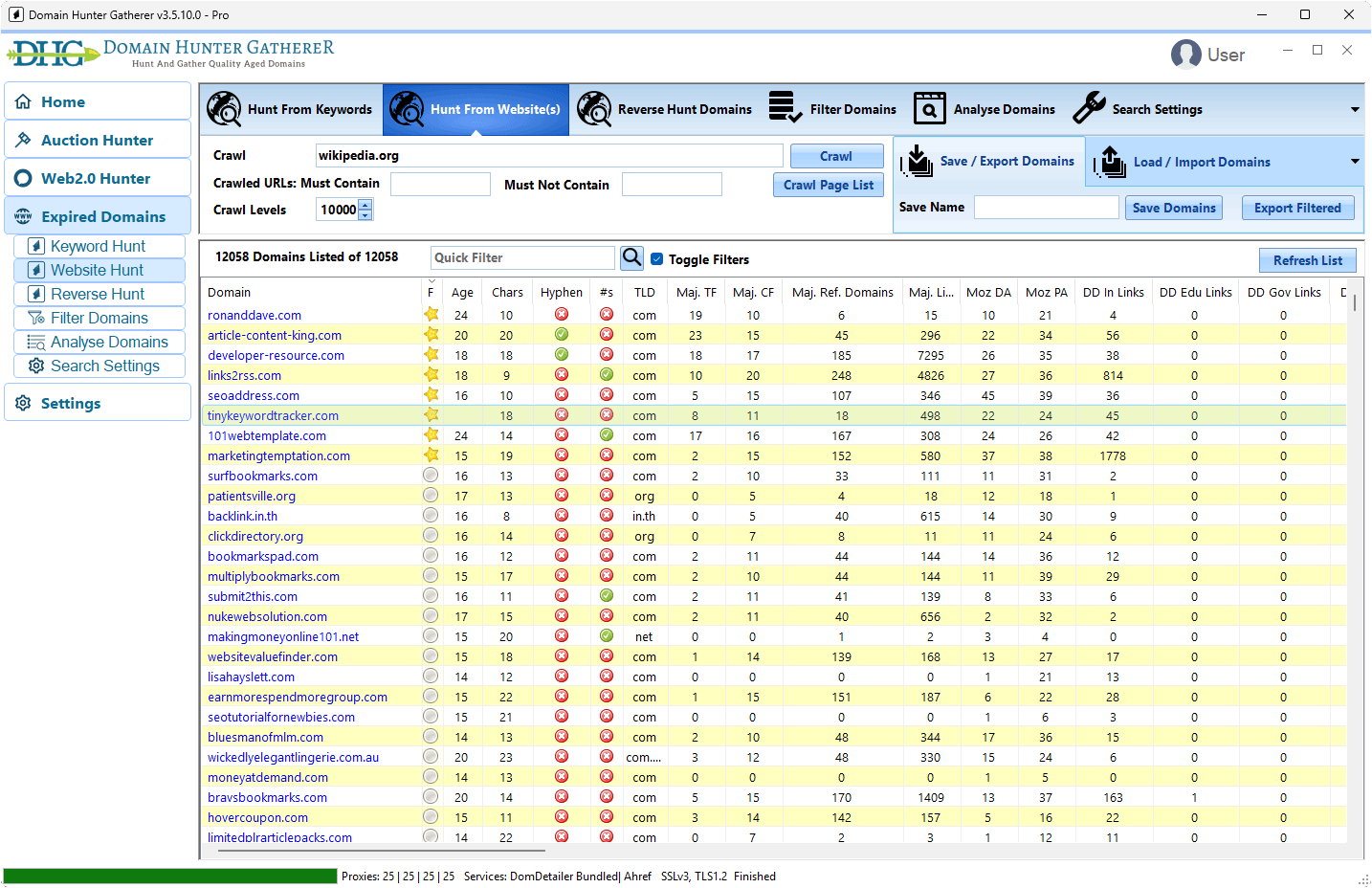
Domain Hunter Gatherer is a Windows desktop hunter, not a hosted expired-domain census. You seed keywords, a niche, or a competitor site; it crawls pages, checks which names are still available, and scores the hits. A separate module scans auction marketplaces. It does not register or bid on auctions, purchase happens at the registrar or auction site.
Free Forever covers Domain Auction Search only (homepage sources: GoDaddy Auctions, NameCheap Market, Flippa, Above, Dynadot Aftermarket, HugeDomains). Premium is $27/month or $247/year and unlocks the Keyword, Niche, and Authority crawlers. Pro is $97/month or $679/year and adds Easy Expired Domains, DomRecovery, helpdesk, and 50,000 DomDetailer credits per month for Moz and Majestic pulls (checked September 2, 2026).
Dimension
Score
Why
Inventory
Limited★☆☆
No live catalog count; crawl + auction slice + Easy Expired on Pro
Spam
Good★★☆
In-app spam filters, Moz/Majestic via DomDetailer; no private-list credits
SEO
Good★★☆
Keyword, niche, and authority crawlers; no semantic or Local Search
Workflow
Limited★☆☆
Desktop shortlists and exports; no cloud ops dashboard
API
No API-
No public REST API or MCP
Price
Good★★☆
Free auctions; Premium $27/mo; Pro $97/mo; Windows only
There is no single “All = N” counter. Inventory is three layers: your live crawl (throughput depends on seeds, threads, and proxies), a combined auction scan of a named slice, and Easy Expired on Pro (vendor claim: over 110 million expired domains). Easy Expired is the register-at-reg-fee layer already found in ExpiredDomains.net, DomCop, SpamZilla, and UpSnatch. Pending-delete is not a DHG SKU. DomCop Guru is the closest cloud cousin if you want a hosted crawler instead of a local Windows install.
Domain Hunter Gatherer Pro Website Hunt results with Moz and Majestic columns (September 2, 2026)
DHG is useful if your job is “crawl this competitor tonight” and surface names that may not sit in today’s hosted tables. DomRecovery (Pro) rebuilds old site content from archives after you buy.
The weak points are platform and discovery depth. Windows only, one seat running at a time, no REST/MCP, no Local Search, and no Projects. Spam depth is thinner and less documented than SpamZilla or Karma Score. Current marketing emphasizes Moz DA/PA and Majestic TF/CF; do not assume Ahrefs DR. Payments go through PayPro Global; enquiry routing names Dom Huga Ltd.
Best for: Windows keyword/niche/authority crawls
Skip when: you want a browser mega-list, Local SEO or Niche monitoring, team Workflow, or API/MCP automation.
Where you actually buy or catch the name
None of the tools in this comparison actually register or catch domains for you. They are research and discovery tools: you use them to find, filter, and evaluate names. The actual purchase or registration happens through registrars and auction platforms such as GoDaddy, Dynadot, or Namecheap, while expiring domains that need to be caught are handled by drop-catching services such as DropCatch, CatchClub, or NicSell.
By Nick Vanderhoven
Scoring details: how the points work
Stars reflect what each product currently offers, based on hands-on testing where available and vendor documentation or public product data where it was not. Inventory figures are vendor-reported, and the six dimensions are scored separately rather than combined into one overall score.
Inventory. We look at the types of domains covered, the reported size of the database, and the number of supported TLDs. Broader coverage across auctions, dropped domains, marketplaces, and other listing types scores higher.
Spam. This measures how deeply a tool helps you investigate domain quality and abuse history. We look at spam scoring, Wayback analysis, backlink signals, TF/CF, historical snapshots and titles, WHOIS history, and detection of risky past content such as adult or casino use.
SEO. This covers both traditional SEO data and domain discovery. Backlink counts and Majestic topical data form the baseline, while semantic or neural search, query expansion, Local SEO discovery, nearby places and landmarks, niche projects, and ongoing niche monitoring push the score higher.
Workflow. We look at how well a tool supports repeated research rather than one-off searches. That includes alerts, watchlists, shortlists, comments, structured reviews, operational dashboards, recurring digests, and managing multiple niches or clients in parallel.
API. This measures how much of the product can be used outside its web interface. Public REST APIs, MCP support, search endpoints, and single-domain enrichment all count, while plan restrictions and rate limits do not improve the score.
Price. This reflects how easy it is to start using the product, not its overall value. A genuinely usable free search tier scores much better than a limited preview, while lower-priced paid plans also improve the rating.
Points to stars. Each dimension is scored independently and converted to ★★★ (Best), ★★☆ (Good), or ★☆☆ (Limited) relative to what that category can offer. The stars highlight strengths and weaknesses by dimension; they are not an overall ranking of the tools.
Frequently asked questions
What is the best free expired domain tool?
ExpiredDomains.net is the best free option for raw volume. The whole product is free, with 770M+ reported domains across 676 TLDs as of September 1, 2026. UpSnatch also offers free Classic Search on its full database (56.4M domains, 1,338 TLDs), with 20+ free filters including TLD, name structure, listing type, bids, SEO metrics (backlinks, DR, TF/CF, age), and quality toggles. DomCop has no free plan.
What is the best expired domain tool for SEO?
UpSnatch is the strongest fit for SEO discovery in this comparison: Magic Search finds names by meaning, and Projects support niche monitoring over time. SpamZilla is next when spam triage and backlink/Wayback review come first. You still validate in Ahrefs, Majestic, and Wayback before you buy.
What is the best expired domain tool for Local SEO?
UpSnatch is the strongest Local SEO fit in this comparison. Local Search starts from a place you care about and shows expired, auction, and marketplace names that belong to that market: the city plus nearby neighborhoods and local context, not only domains that contain the city string. The other tools stay on keywords, filters, metric grids, or auction tables and have no dedicated local discovery.
See what UpSnatch finds for you
Start searching UpSnatch for free. No credit card required.

 Join with Google